Indeed, in order to achieve success with Google Adwords, a digital marketer must channel their inner DIY enthusiast, and learn the fundamentals before proceeding any further. In an earlier post, I discussed the details, benefits and drawbacks of paid web advertisement. Given the background information at hand, the next step to understanding Google Adwords would be learning how to set up an Adwords campaign.
Simple Steps to Setting Up an Adwords Campaign
Similar to the process of evaluating your surroundings to figure out what type of shelter to build, the first step in Google Adwords is gauging the environment to select a campaign type. There are three main types of campaigns: search network only, display network only, or both search and display networks. In summation, search networks focus on textual communications with the consumer, display is more imaged based, and the combined product is rich in both imagery and text (I expand on these networks in the post linked above). Customers also have the option of choosing campaign sub types: standard is for a simpler and faster Adwords effort, whereas "all features" provides greater customizability for your ads.
The next step in Google Adwords is to establish structure for your campaign. Much like how Primitive technology lays out the barebones skeleton of a structure before adding to it, digital marketers must understand the conceptual framework they wish to implement to guide the campaign. According to Google Adwords exam study guide, campaign structure is broken down into three simple components:
The third step in creating an Adwords campaign is targeting your audience. One of the most important parts of search engine marketing is designing your content to be relevant to the search of a consumer. Methods include creating content that a typical consumer in the market would search for, or matching the URL to reflect the content of the page it renders. Above all, the most effective technique for reaching the target audience, the group that is mot likely to be interested by your content, is by optimizing your site's use of keywords. Based on varying relevancy of a search to your advertisement, you can choose to run variations of an ad, with differences as subtle as matching the phrase in the results to the phrase that was searched. In addition, you can also choose to target specific groups of people. One popular target for digital marketers is affinity audiences, or groups that have expressed interest in your product in the past. Categories can be narrowed down by what time of demographics are most likely to visit the webpage, providing additional consumer insight.
 On the note of keywords, another crucial part of an Adwords campaign is using keywords to create ad groups. Obviously, ads within an ad group are very similar aimed at appealing to the target audience in slightly different ways. The similarity of approach in an ad group is tied together by a string of theme-defining keywords. A huge chunk of keywords can actually be estimated intuitively, since marketers know the content as well as the preferences of the target market. Logically, of course, keywords in ads should also reflect the theme of an ad, contributing to a cohesive ad group. Another important element is including negative keywords, which when searched, will actually prevent your ad from showing up in an irrelevant search, thus reducing costs for less-than-promising ad clicks. Using relevant keywords is like thatching your roof with palm fronds: rainfall that lands on the roof is directed by a collection of strategically positioned leaves, eventually discarded off the roof and into a water receptacle, much like the process of consumers being guided to a destination by a search result rendered from a series of keywords.
Measuring and Optimizing Performance
A continuing trend in this blog is perpetual reflection on the progress one makes and the product one completes. Positive performance of an ad reinforces the techniques from which it was born. Just as a dry night of shelter under a thatched roof is a metric of success for Primitive Technology, a digital marker must evaluate their own set of metrics to determine the performance of their Adwords efforts. One popular metric is conversion tracking, where a marketer inserts a snippet of HTML or Java code into a web page that shows up when a transaction is completed, so a connection is established between the number of clicks to a paid ad and the number of successful purchase decisions it creates. Of course, as I've mentioned in an earlier post, an effective tool for measuring and analyzing this metric is Google analytics, which records patterns over time, and helps digital marketers arrive at insightful conclusions.
In conclusion, using Google Adwords is kind of like building a mud hut with a roof thatched with palm fronds: one must work with the elements available to them, develop a structure, and properly execute the contributing integral pieces in order to achieve a positive result. Using Google Adwords is an excellent tool for digital marketers, since the process for creating an ad and justifying their work with research is essentially laid out for them with a simple, yet effective software.
Simple Steps to Setting Up an Adwords Campaign
Similar to the process of evaluating your surroundings to figure out what type of shelter to build, the first step in Google Adwords is gauging the environment to select a campaign type. There are three main types of campaigns: search network only, display network only, or both search and display networks. In summation, search networks focus on textual communications with the consumer, display is more imaged based, and the combined product is rich in both imagery and text (I expand on these networks in the post linked above). Customers also have the option of choosing campaign sub types: standard is for a simpler and faster Adwords effort, whereas "all features" provides greater customizability for your ads.
The next step in Google Adwords is to establish structure for your campaign. Much like how Primitive technology lays out the barebones skeleton of a structure before adding to it, digital marketers must understand the conceptual framework they wish to implement to guide the campaign. According to Google Adwords exam study guide, campaign structure is broken down into three simple components:
- Account: Your account is associated with a unique email address, password, and billing information.
- Campaigns: Each campaign in your account has its own budget and settings that determine where your ads appear.
- Ad groups: Each ad group within a campaign contains a set of similar ads and keywords that you want to trigger your ads to show.
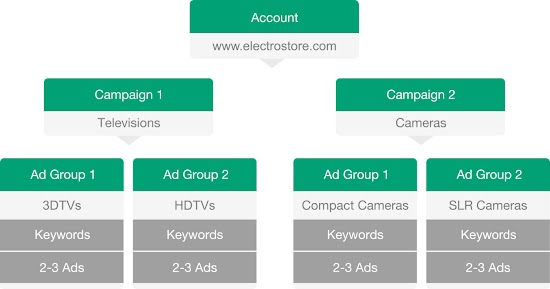 |
| The structure for a typical Adwords campaign |
The third step in creating an Adwords campaign is targeting your audience. One of the most important parts of search engine marketing is designing your content to be relevant to the search of a consumer. Methods include creating content that a typical consumer in the market would search for, or matching the URL to reflect the content of the page it renders. Above all, the most effective technique for reaching the target audience, the group that is mot likely to be interested by your content, is by optimizing your site's use of keywords. Based on varying relevancy of a search to your advertisement, you can choose to run variations of an ad, with differences as subtle as matching the phrase in the results to the phrase that was searched. In addition, you can also choose to target specific groups of people. One popular target for digital marketers is affinity audiences, or groups that have expressed interest in your product in the past. Categories can be narrowed down by what time of demographics are most likely to visit the webpage, providing additional consumer insight.
On the note of keywords, another crucial part of an Adwords campaign is using keywords to create ad groups. Obviously, ads within an ad group are very similar aimed at appealing to the target audience in slightly different ways. The similarity of approach in an ad group is tied together by a string of theme-defining keywords. A huge chunk of keywords can actually be estimated intuitively, since marketers know the content as well as the preferences of the target market. Logically, of course, keywords in ads should also reflect the theme of an ad, contributing to a cohesive ad group. Another important element is including negative keywords, which when searched, will actually prevent your ad from showing up in an irrelevant search, thus reducing costs for less-than-promising ad clicks. Using relevant keywords is like thatching your roof with palm fronds: rainfall that lands on the roof is directed by a collection of strategically positioned leaves, eventually discarded off the roof and into a water receptacle, much like the process of consumers being guided to a destination by a search result rendered from a series of keywords.Measuring and Optimizing Performance
A continuing trend in this blog is perpetual reflection on the progress one makes and the product one completes. Positive performance of an ad reinforces the techniques from which it was born. Just as a dry night of shelter under a thatched roof is a metric of success for Primitive Technology, a digital marker must evaluate their own set of metrics to determine the performance of their Adwords efforts. One popular metric is conversion tracking, where a marketer inserts a snippet of HTML or Java code into a web page that shows up when a transaction is completed, so a connection is established between the number of clicks to a paid ad and the number of successful purchase decisions it creates. Of course, as I've mentioned in an earlier post, an effective tool for measuring and analyzing this metric is Google analytics, which records patterns over time, and helps digital marketers arrive at insightful conclusions.
 |
| Conversion tracking |
In conclusion, using Google Adwords is kind of like building a mud hut with a roof thatched with palm fronds: one must work with the elements available to them, develop a structure, and properly execute the contributing integral pieces in order to achieve a positive result. Using Google Adwords is an excellent tool for digital marketers, since the process for creating an ad and justifying their work with research is essentially laid out for them with a simple, yet effective software.

No comments:
Post a Comment