Thursday, March 10, 2016

What I Can Do for You as a Digital Marketer

Another day, another marketer. That's my perception of the real world of marketing, beyond the university doors and out in the jungle of free enterprise. Colleges are cranking out marketing graduates every quarter; it's one of the most popular degrees in the country. Competition is stiff, especially for entry levels, so I can't help but ponder my future as a marketing graduate. How does one keep from feeling like just another drop in the ocean?

Clearly, the answer is to develop some sort of differentiation, some unique quality that companies will value more in me than my fellow competing graduates. I received some advice from a friend recently: "to be the best at what you do, you have to love doing it." based on my recent studies in digital marketing, I think I've found my differentiator. Digital marketing has always been a fascinating topic for me, as it combines two job descriptions from opposite ends of the marketing spectrum: conceptual thinking and technical work. I love them both, and have a passion for mastering my interests as a progress through my career. In a sense, one of my career goals is to become a full stack marketer. My studies in digital marketing have been a great starting point for that journey.Not only did we cover a myriad of marketing topics in the course, we also obtained tangible digital marketing skills that increase our value in the eyes of prospective employers! At the close of the quarter here at Western Washington, I am compelled to reflect on my studies, synthesizing all of the skills that I have gained that qualify me to gain a position as a digital marketer!

The key to success in digital marketing is to branch out and learn all of its facets!


One of the first subjects we covered was analytics (especially Google Analytics). Google Analytics is an excellent tool for evaluating and interpreting digital data at a very affordable rate (free!). In order to produce a search report, Google Analytics completes a four-step process, converting raw data into a finished product.

  • Collection: every instance of recordable activity a consumer inputs upon page is accounted for by Google Analytics. All devices with the ability to internet search are registered by GA. Snippets of HTML code are inserted into page URLs to record bits of relevant data. 
  • Configuration and Processing: data is grouped together based on the parameters of a search. Once grouped, the data can be filtered according to search ,and render simple results pertaining to the search.
  • Reporting: The results are formatted to streamline communication digestion for the average professional I. Reports often focus on KPI's like page views, length of time spent on site, and frequency of visitation.
I learned a lot from Google Analytics, and am now officially Google Analytics Certified! I can't wait to put my knowledge of analytics and my curiosity for web data to the test!


Another valuable skill I acquired in digital marketing is the ability to manage social media effectively and efficiently. The primary focus for any brand looking into social media marketing should be to deeply entrench themselves into online communities relevant to the product. When an understanding of the community is obtained, the release of relevant content is more effective in evoking engagement among the community. Once the nature of the content provided on social media has a solid direction, the next step for digital marketers is organizing the swath of marketing messages sent out to customers over various platforms. This undertaking requires a considerable amount of skill, so to qualify my obtained proficiency, I took the Hootsuite Certification exam.

Fundamentally, Hootsuite offers various content publication tools for marketers to organize content and analyze specific results. For example, Hootsuite offers a "stream" tool where marketers create "streams" or specific groups of consumers (in terms of demographics, psychographic, preference, etc.) where they can customize what content goes out to that group and through which platform. While social media marketing often focuses on being proactive with communication, it is also crucial to be skilled at take=ing reactive measures to solve real-time issues. Through Hootsuite, digital marketers can practice social listening, where the software keeps track of social media conversations regarding the brand, accounting for positive or negative sentiment. If the sentiment turns sharply negative in a short amount of time, the marketers are notified, often in time to craft a suitable response. In my time in digital marketing, I also obtained a certification as a Hootsuite Certified Professional!

Throughout my experience in digital marketing education, HubSpot has been a massive contributor of educational content that has certainly provided valuable insight into some of the skills and practices involved with digital marketing. The mere fact that I am aware of and feel appreciation for the brand is a testimonial to the effectiveness of the concept of inbound content marketing. HubSpot's philosophy is that if a company invests in producing educational content relevant to the industry, without any publication bias, the consumer will be so appreciative of the content that they will align their loyalties with that company. What previously seemed like a risky investment is now generally accepted across the industry to be a valuable piece of digital marketing. Hubspot also taught me other important digital marketing concepts like creating a buyer persona through a mixture of data analysis and personal interaction with a segment. Creating a narrative about the ideal individual in a target market is a useful tool in designing content for that market. The end goal of the Hubspot inbound marketing process is to guide the consumer through the buyer's journey, providing relevant information appropriate for every level of increasing commitment. Progressing through to the next phase of my digital marketing education, I made sure to acquire the Hubspot certification as well.


The final piece of my digital marketing education involves Google Adwords, and the system of commerce that surrounds it. The idea behind Google Adwords is all about optimization: optimize the ad content to be relevant and enjoyable for the consumer, optimize the consumer response to an ad, and optimize the general ad content that exists on the results page of a Google search. It's a win-win-win, the consumer wins, the businesses win, and Google wins-- if every component plays their role, that is. Basically, the way the Google Adwords ad buying system works is that there is a base algorithm that weighs the bid a company makes for ad space against the quality of the content within the ad. If the content is actually well structured and is relevant to the initial search, the ad is deemed to be of good quality, and ranks high. If the ad is not of high quality, then the highest bidder may not actually receive the highest search result, especially if another bidder produced a better ad. This system of advertising is really useful when paired with Google Analytics, where certain ad metrics can be tracked and evaluated over time to give companies insight into the effectiveness of their ads. In the next week, I plan to acquire a certification in Google Adwords as well, and I'll be continuing on my way to become a full stack marketer!

Let's see.... what'd I miss?
I learned a lot more over the course of my digital marketing. I did blog about each of these subjects in depth, but here's a quick summation:
  • Basic Proficiency in HTML/CSS
  • Basic Proficiency in SQL database programming
  • A/B Testing
  • Contemporary Content Marketing
  • UX/UI
  • Search Engine Optimization (SEO)
  • Email Marketing
  • Search Engine Marketing (SEM)
  • Programmatic Buying 
  • Native Advertising
  • Platform Switching/Mobile Marketing


Perkins Workin's Statistics

Total Word Count: 16,634, or 48 pages in a Word Document

Total Page Views: 282 
I'm pretty proud of this metric! I linked my blog to a few Facebook groups a couple times and got some extra hits. I also seem to cultivating a small but consistent base of Polish followers. I have no idea why, but there always seems to be a few Polish clicks for every post. 

Most Popular Posts: 
  1. Predictably Irrational: A Foray into SEM
  2. Social Media from Both Sides of the Coin
  3. I Can See Clearly Now.... Because of A/B Testing
  4. Technical Marketing II: the SQL
I have a theory that the SEM post was the most popular solely due to my referencing of the famous marketing book Predictably Irrational.

Well folks, that's all I have to say about that.... for now. I plan to continue this blog in the future, but for now, a little respite from all these Workin's.

Thanks for reading!

John Perkins


Tuesday, March 8, 2016

A Look into Platform Switching and Modern Mobile Marketing

If technology truly does advance at a near exponential rate, the notion seems more astounding with every year one ages. I remember enjoying tinkering with my dad's brick of a cell phone at age 7, as I was then at the cutting edge of technology. Here I sit, a mere 15 years later, reflecting on how that phone (and so many pieces of tech from the 90's) has been rendered obsolete. 15 years! How much time spanned between the first landline and the first cell phone? Roughly 100 years. Technology moves fast, and as a marketing student at age 22, I have a unique perspective on how these changes shape people and markets. I was brought up in the thick of changing digital consumption, from early cell phones to functional laptop computers to smart phones, to tablets.
Cell phones have evolved into a valuable tool for consumers and marketers

As a marketer, these technological advancements pose new and unique challenges for digital marketers:

Platform Shifts: not only are marketers using new, different devices to consume digital content; they are doing it simultaneously across multiple platforms. Consumers tend to rapidly switch between forms of digital content, sometimes consuming two pieces on two different platforms at the same time.

Content Shifts: to compensate for these developments in consumer behavior, marketers are re-thinking the content released on these digital platforms, reframing them with the aim to make advertising as engaging as possible.

Demographic Shifts: digital consumption is dominated by the millennial generation, brought up in the midst of these rapid changes. Digital marketers focus specifically on trends in millennial behavior, in order to gain insight on consumer behavior for years to come.

Marketing Shifts: in reaction to all of these subsequent changes in the digital industry, more marketing dollars are being poured into digital marketing, especially cross-platform usage. Digital tools like Google Analytics refine the process in revolutionary ways, allowing for laser focus on a target market, reducing the waste of advertising dollars.

One the most telling developments in the technological landscape has been the penetration of smartphones and tablets in the digital consumption market. According to comScore, in three years (from 2010 to 2013), time spent on mobile devices nearly tripled, time spent on tablets increased by a factor of 10. It seems now that mobile consumption has usurped desktop use in the market. 

Mobile acquiring the the top spot for content consumed is not only a characterization of the market, but also a bit symbolic of the times we live in. Mobile usage is innately fast paced, ideal for consumers looking for content on the go. Has this trend shaped the lifestyle of the consumer, and their expectations for digital content?

To answer that question, we must delve into why platform switching is a growing activity, and what types of marketing resonates with this group. 

According to Milward Brown, 41% of time spent consuming digital media is over multiple devices, signifying tangible growth in the platform switching arena. 70% of multiple platform consumption is stacking (viewing multiple pieces of unrelated content). Based on these statistics, perhaps consumers that switch platforms do so to escape other forms of digital content, to optimize the entertainment of informational value of their time. Milward Brown states that the most popular reasons for switching include: filling time during ad breaks, keeping up with friends on social media, or having the TV in the background for ambient noise.

Indeed, it seems that content switching, especially from TV to mobile, is mostly driven by intentions to fit in other forms of content consumption while the current form isn't as engaging. Yet, Milward Brown records that the most favored and attention getting form of media is still the TV. So most media consumption is captured by mobile, but consumers pay more attention more engaging media like TV? How the heck does a marketer utilize that behavior to promote their message? Milward Brown has a few answers for that, too! The types of ads people are most attentive and receptive to TV ads linking to a brand's web presence, or promoting a mobile app. Consumers are also responsive to shorter, more "shareable" advertisements and online ads promoting TV shows in advance. One big takeaway from this data is the growing popularity of cross-platform promotion, where consumers will be directed toward content on a different device than they are currently using. With this method, digital marketers would be utilizing the tendency to platform switch, by providing the type of content that induces a platform switch in the first place. They are advertising a piece of content that may help optimize the consumer experience, so a platform switch is induced, and engagement is retained.

So how does this knowledge translate into marketing activity?

Focus on apps. According to Think with Google, 85% of all mobile searches are through phone applications. Optimizing a brand's app or a brand's connection with an app could be crucial to succeeding in the digital marketplace. Another stat I found interesting is that one in two mobile users turn to mobile to apps to make purchase decisions. Not only have phones reached a point of ubiquity in our lives, but some apps have reached a point of ubiquity on our phones, almost as if it was a built in feature. Apps, to me, embody the general difference between mobile and desktop. They are fast, easy to use, convenient, and often shallow in content. They are essentially synonymous with mobile at this point, capturing the majority of digital consumption in the modern era. Digital marketers should aim to get involved with mobile and apps, designing them around the idea of convenient, easy alternatives to something more focus intensive like TV.


Thursday, March 3, 2016

Futuristic Mixing: Programmatic Buying vs Native Advertising

I look forward to the future, especially regarding the increasing rapidity of breakthroughs in technology. I'm excited by the prospect of self driving cars, despite the concerns of some that American car culture may eventually die out. While I was initially fine with that notion anyway, I concede that it is important that with every significant advancement of technology in our lives, we take a moment to reflect upon what is gained, and what is lost. With self driving car, we will be trading in long, comfortable naps while cruising down the freeway for "muscle heads" and American Chopper. Although the path of technology for a concept as singular as self driving cars is at this point somewhat destined to be fulfilled, the crystal ball of digital marketing appears to be a tad murky when it comes to the subjects of programmatic buying and native advertising. Indeed, it seems that the technology of ad buying is progressing toward automation, transforming a task previously requiring human oversight. On the opposite end of paid advertisement, long-form ads are calling for even more personal attention and immersion amongst regular content, weighted with the ethical responsibility to avoid blurring the lines between content and advertisement.

Google self-driving cars are inevitable as technology advances
What does programmatic buying hold for the future of paid advertisement?

The intention behind programmatic buying is to increase the efficiency of ad purchases. Programmatic removes the human element, making data driven purchase decisions with an immediacy that outstrips human ability, bypassing superfluous and obsolete paperwork formalities like insertion orders. As Pete Naylor of NBCUniversal puts it, "Programmatic is a catchall term from behavioral and intent-based targeting to real-time bidding and exchange-based buying of inventory." The effectiveness of specified targeting and speedy buying fosters a buying environment similar to the bidding ad market system Google uses.

Although programmatic buying brings a lot of new benefits to the table, it also draws several legitimate criticisms. One of the most significant obstacles for programmatic is addressing the multi-device lifestyle of the typical consumer. Currently, the market is not optimized for a multi-channel ad buying environment, which leads to a lot of sticky purchase situations. There have also been issues with the transparency of the market. The sellers within the programmatic system have not provided enough information to how effective the content is going to be on conversion rates, or what metrics are the most significant influencers.

Given the current benefits and drawbacks of programmatic, what can we expect to see from the industry in the years to come? A blog post from Richard Joyce forecasts more rapid growth, where programmatic budgets expand, permeation into the video market will increase, and targeting will be refined enough to focus on individuals, as well as traverse the multi-channel behavioral landscape that currently lacks market organization. ComScore, a prominent programmatic seller, also has the future in mind. In 2015, ComScore announced the availability of a package of pre-bid metrics called Trust Profiles that give buyers insight to the quality of content. Evidently, the major qualms with programmatic buying are in the process of finding solutions; the industry is set up for even more rapid growth in the next 5 to 10 years.
ComScore aims to expand product to apply to multiple channels
Native Advertising Continues Rise to Popularity

Another burgeoning aspect of digital paid advertising is native advertising. Native advertising is similar to content marketing in that it provides useful or entertaining information for consumers browsing the web. However, it distinguishes itself from traditional content marketing due to the fact that it is sponsored content, an ad inserted into content with the intent to mimic non-sponsored content. From one perspective, the ideal piece of native marketing would be branded so subtly that the consumer wouldn't be able to detect an advertisement nestled in amongst the content they consume. Unfortunately, this take on the subject can at times be problematic, and may be a hindrance to the growth of the trend.

Indeed, the seamlessness of native advertising's integration with content can be perceived as eerie or creepy; some consumers feel deceived by "shady" marketing activities. To some extent, they're right. Another criticism of native advertising is the lack of adequate analytical support, relative to traditional paid advertisement. Without a major vehicle to gather data on consumers, native marketing is unable to establish a precise target market.

Despite the cogs in the native marketing system, there appears to be a bright future ahead. Producers of quality native marketing understand that there needs to be a "clear dividing line between editorial and advertising content." In a recent example from the podcast "Startup," creator Alex Blumberg discusses an instance where the line between ad and content was accidentally blurred. Although there was a fair amount of outrage from the user base, the good intentions of the podcast prevailed, and the issue dissolved. Although that conflict was resolved, it serves as a testament to the value consumers place in trusting a brand. The analytics may not be in place yet, but consumer patterns have identified native advertising to have a positive and cost effective impact on conversion rates.

The Future is Near

As both branches of paid advertisement continue to progress, one common development for both is the surfacing of premium pricing. Programmatic sellers are beginning to extend offers of premium content at higher CPM rates. Eventually, as Jeffrey Rayport of Harvard Business Review points out, programmatic ad buying will expand beyond the hyper-current internet ad space scene, out into the mainstream until it reaches a point of ubiquity. Native advertising seems to be following a similar path. Although native advertising is a broad term, referring to short brand plugs within content, or long-form pieces that emulate content, the method has grown in popularity enough for higher quality service to earn sustainable demand. According to Aptly, native advertising is also themed toward ubiquity: the future will be characterized by native advertising permeating social media platforms and apps.
Technology and business only move in one direction: forward
Overall, my opinion of the future of growth of programmatic buying and native advertising is similar to my opinion of impending integration self driving cars: the will be some gains, and some losses. By definition, technology serves to reduce the amount of human effort required to complete a task, leaving us with more time to sleep in the back seat, or work without being dragged down by formalities and inconveniences.

Tuesday, March 1, 2016

Building Adwords from Ground Up

Recently, I came across the Youtube channel Primitive Technology, where a solitary man records himself demonstrating advanced wilderness survival methods in some unknown, remote forest. This guy builds everything from scratch: to insulate the walls of the hut he constructs, he digs the clay that becomes the pot that carries water to create the mud that is added to the woven branch walls of the hut. Quite a lengthy process, I'm sure, but mesmerizing to watch nonetheless. Even more recently, I've been reading up on Google Adwords, the premiere vehicle of function for search engine marketing. Google Adwords allows digital marketers to structure, strategize, and design campaigns from the ground up. Maybe I've been binge watching Primitive Technology a little too much, but I couldn't help but notice some glaring similarities between a guy that builds miscellaneous objects in the woods and a digital marketer using Google Adwords for a company. Let's see: both require comprehensive knowledge of the fundamentals, both rely on incremental installments to eventually create a finished product, and both have to be willing to get their hands dirty to strengthen the foundation of their creation.


Indeed, in order to achieve success with Google Adwords, a digital marketer must channel their inner DIY enthusiast, and learn the fundamentals before proceeding any further. In an earlier post, I discussed the details, benefits and drawbacks of paid web advertisement. Given the background information at hand, the next step to understanding Google Adwords would be learning how to set up an Adwords campaign.

Simple Steps to Setting Up an Adwords Campaign

Similar to the process of evaluating your surroundings to figure out what type of shelter to build, the first step in Google Adwords is gauging the environment to select a campaign type. There are three main types of campaigns: search network only, display network only, or both search and display networks. In summation, search networks focus on textual communications with the consumer, display is more imaged based, and the combined product is rich in both imagery and text (I expand on these networks in the post linked above). Customers also have the option of choosing campaign sub types: standard is for a simpler and faster Adwords effort, whereas "all features" provides greater customizability for your ads.

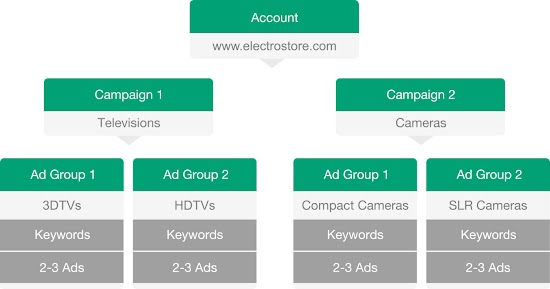
The next step in Google Adwords is to establish structure for your campaign. Much like how Primitive technology lays out the barebones skeleton of a structure before adding to it, digital marketers must understand the conceptual framework they wish to implement to guide the campaign. According to Google Adwords exam study guide, campaign structure is broken down into three simple components:

  • Account: Your account is associated with a unique email address, password, and billing information.
  • Campaigns: Each campaign in your account has its own budget and settings that determine where your ads appear.
  • Ad groups: Each ad group within a campaign contains a set of similar ads and keywords that you want to trigger your ads to show.

The structure for a typical Adwords campaign


The third step in creating an Adwords campaign is targeting your audience. One of the most important parts of search engine marketing is designing your content to be relevant to the search of a consumer. Methods include creating content that a typical consumer in the market would search for, or matching the URL to reflect the content of the page it renders. Above all, the most effective technique for reaching the target audience, the group that is mot likely to be interested by your content, is by optimizing your site's use of keywords. Based on varying relevancy of a search to your advertisement, you can choose to run variations of an ad, with differences as subtle as matching the phrase in the results to the phrase that was searched. In addition, you can also choose to target specific groups of people. One popular target for digital marketers is affinity audiences, or groups that have expressed interest in your product in the past. Categories can be narrowed down by what time of demographics are most likely to visit the webpage, providing additional consumer insight.

On the note of keywords, another crucial part of an Adwords campaign is using keywords to create ad groups. Obviously, ads within an ad group are very similar aimed at appealing to the target audience in slightly different ways. The similarity of approach in an ad group is tied together by a string of theme-defining keywords. A huge chunk of keywords can actually be estimated intuitively, since marketers know the content as well as the preferences of the target market. Logically, of course, keywords in ads should also reflect the theme of an ad, contributing to a cohesive ad group. Another important element is including negative keywords, which when searched, will actually prevent your ad from showing up in an irrelevant search, thus reducing costs for less-than-promising ad clicks. Using relevant keywords is like thatching your roof with palm fronds: rainfall that lands on the roof is directed by a collection of strategically positioned leaves, eventually discarded off the roof and into a water receptacle, much like the process of consumers being guided to a destination by a search result rendered from a series of keywords.

Measuring and Optimizing Performance

A continuing trend in this blog is perpetual reflection on the progress one makes and the product one completes. Positive performance of an ad reinforces the techniques from which it was born. Just as a dry night of shelter under a thatched roof is a metric of success for Primitive Technology, a digital marker must evaluate their own set of metrics to determine the performance of their Adwords efforts. One popular metric is conversion tracking, where a marketer inserts a snippet of HTML or Java code into a web page that shows up when a transaction is completed, so a connection is established between the number of clicks to a paid ad and the number of successful purchase decisions it creates. Of course, as I've mentioned in an earlier post, an effective tool for measuring and analyzing this metric is Google analytics, which records patterns over time, and helps digital marketers arrive at insightful conclusions.


Conversion tracking

In conclusion, using Google Adwords is kind of like building a mud hut with a roof thatched with palm fronds: one must work with the elements available to them, develop a structure, and properly execute the contributing integral pieces in order to achieve a positive result. Using Google Adwords is an excellent tool for digital marketers, since the process for creating an ad and justifying their work with research is essentially laid out for them with a simple, yet effective software.