 |
| Create the juiciest tomato to be picked first at the market. |
In order to understand the methodology behind the practice of SEO, it is important to comprehend the processes Google employs to reach a search result in the first place. Google's expansive network of pages is "crawled" by spider software, obtaining essential information and indexing the pages it finds. Basically, the existence of a web page is acknowledged by Google if another site links to it. In this sense, all web pages indexed by Google are part of the same indexed ocean, all linked together by at least on site referencing another. In the farm analogy, the juiciest tomatoes are the top organic search results for Google (and Bing too, I guess, but Google holds 80% of the market share). In reality, popular results are determined by a combination of factors: relevance of title, relevance of content, clarity of URL, and most importantly, gained credibility from other sites linking to the page.
So what exactly can marketers do to improve the ranking of their page's search results? Google has a few suggestions.
- Write content for users, rather than search engines. You want to make sure the content of your page actually reflects the search of the user. If you design your page to be a popular option for Google's indexing software, rather than have actual content reflecting a user search, that is considered cloaking, which is both unethical and less effective in increasing search rank.
- Add clarity to the site's <title> elements and ALT attributes (text that shows up in place of an image if it can't load). Ensuring that the HTML coding behind a web page's content is clear and relevant is crucial to a site's rankings.
- Include keywords in a descriptive, human-friendly URL. This renders your page easily digestible to the human eye, as well as clear to the relevance of a search.
 |
| FinTech used SEO practices to get a boost in online traffic. |
In previous blog posts, I've discussed the utility of inbound marketing. Creating content that consumers have a need for is certainly effective in increasing their preference for your brand. It is important to make the connection between inbound marketing and SEO! SEO is definitely a component to the function of inbound, contributing as one of the major technical tasks that comprise an inbound effort. Using SEO in your inbound marketing tactics will serve to optimize the visibility of your content, and refine your target market by returning for more relevant searches. FinTech's case is a great example of a success story in SEO. After burning out on traditional outbound marketing practices, the enlisted the help of HubSpot to improve flow to their site. The learned SEO and inbound marketing practices allowed FinTech to create optimal landing pages, as well as adapt their content to better fit the search needs of their target consumer. Since the beginning of their efforts with HubSpot in December 2013, FinTech has seen a 165% increase in leads, a 174% increase in website traffic, and an 83% increase in organic traffic. For FinTech, adopting SEO techniques certainly paid off.
 |
| The credibility rabbit hole is quantifiable beyond our imagination. |
Digging into a page's components is a major factor to optimizing your webpage, but as I stated earlier, the most significant part of SEO is increasing your site's popularity and relevance through building links. Moz defines link building as "the process of acquiring links from other websites to your own." The more links your site acquires, the more credible it becomes. Of course, Google, judges the credibility of your links from the credibility of the sites from which the links originated. However, consider how those sites attained the credibility to make the links to your website credible! Can you fathom how deep the rabbit hole goes? It doesn't matter. The point is, make sure that your link building is honest, from credible sites. Some websites try to buy links from what are essentially bot sites. Google is capable of sniffing those out, and can actually demote your ranking on the web as a penalty. The overarching idea here is that links between web pages represent relationships. Between sites, between site and user, between site and Google. Link building is worth your time as a digital marketer.
So how do digital marketers engage in link building?
 |
| Link, building. Good one, Moz! |
One of the best ways to build links is fortunately consistent with the topics I've been discussing in Perkins Workin's. In line with content creation and inbound marketing, Moz advises that we start with content-based link building. The idea is that when you create a piece of informative of entertaining content, you gain implied credibility through the audience's enjoyment of the content. This satisfaction is reflected in an increase in "shares" of your content. Open your production up to group collaboration. If you have guest bloggers, a new wave of traffic from their fan base is automatically diverted to their post on your blog! You can also throw out some "ego bait," praising the work of others, earning their endorsement of your site through flattery. Make sure your content is focused on your target market. Specific services fill specific needs. Lastly, follow up on your content. Ask for the input of viewers and other creators. The goal here is to build links through optimizing content, ultimately improving your search engine optimization.
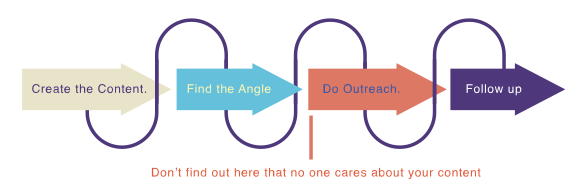 |
| Conceptual framework for content based link building. |
In conclusion, as you farm your online content tomatoes, keep in mind that producing the juiciest tomatoes is beneficial to the market, the customer, and the business. Design your SEO approach around providing the contents Google's spiders search for, like clarity of title, relevancy of content, and compatibility of HTML. However, don't neglect the consumer, who appreciates quality content upon visitation of your page. Balancing the needs of the search engine and the consumer is the key to success in SEO as a digital marketer.

No comments:
Post a Comment